I will likely be coming back to your blog for extra soon

Well, guys, you’ll be happy to learn that I am exceeding expectations, creating something that is needed on the web, and have received not just a thumbs-up, but an enormous thumbs up for my labors!  Seriously, though – do you get blog spam like this?  It makes my day!

“I’m also writing to let you understand of the nice encounter my cousin’s girl experienced going through yuor web blog. She noticed too many details, most notably how it is like to possess an incredible helping heart to get folks quite simply fully understand specific multifaceted things. You really did more than my expectations. I appreciate you for giving the warm and friendly, healthy, educational not to mention easy tips on your topic to Kate.”

“You really make it seem so easy with your presentation but I find this topic to be actually something that I think I would never understand. It seems too complicated and extremely broad for me. I am looking forward for your next post, I’ll try to get the hang of it!”

“Youre so cool! I dont suppose Ive read something like this before. So nice to search out someone with some original thoughts on this subject. realy thank you for beginning this up. this web site is something that is needed on the web, someone with a bit originality. helpful job for bringing something new to the web!”

“Hey! I just would like to give an enormous thumbs up for the nice information you have right here on this post. I will likely be coming back to your blog for extra soon.”

Losses

I know this is all over the Internet and every news channel by now, but I heard that Steve Jobs died today on my way home from work, and it saddened me.  That it saddened me somehow surprised me, too.  It’s not like I knew him, and despite his reputation as a genius in product design, his perfectionism was known to make him brutal to work with.  I probably couldn’t have worked for him, but I certainly did respect him.  As someone who has been into electronic gadgets for years, is a student of business and leadership, living in the Bay Area, where Jobs was more of a legend than anywhere else, and working in technology for so long, perhaps he was a bigger figure in my unconscious than I realized.  I don’t know.  I’m puzzling over it.  As I read the news tonight, I followed a link to the Commencement address that Jobs gave to the 2005 graduating class of Stanford.  In it, he discusses death, having been diagnosed with pancreatic cancer the year before.  I have some issues around death – it’s a rather long story, so I won’t get into it right now, but suffice it to say the topic is generally on my mind more than I’d like it to be.  I’ve included some excerpts from that Stanford speech below.  At the moment – for me, at least – these words from Steve Jobs seem as big a tribute to humanity as any.

“Remembering that I’ll be dead soon is the most important tool I’ve ever encountered to help me make the big choices in life. Because almost everything — all external expectations, all pride, all fear of embarrassment or failure – these things just fall away in the face of death, leaving only what is truly important. Remembering that you are going to die is the best way I know to avoid the trap of thinking you have something to lose. You are already naked. There is no reason not to follow your heart.

No one wants to die. Even people who want to go to heaven don’t want to die to get there. And yet death is the destination we all share. No one has ever escaped it. And that is as it should be, because Death is very likely the single best invention of Life. It is Life’s change agent. It clears out the old to make way for the new.

Your time is limited, so don’t waste it living someone else’s life. Don’t be trapped by dogma — which is living with the results of other people’s thinking. Don’t let the noise of others’ opinions drown out your own inner voice. And most important, have the courage to follow your heart and intuition. They somehow already know what you truly want to become. Everything else is secondary.

Stay Hungry. Stay Foolish.”

Thank you, Steve Jobs.

Timelines

Another exercise suggested in Bill Roorbach’s Writing Life Stories has to do with timelines.  The idea is that you create timelines for various years in your life.  He suggests jotting notes in a box for each month of the year you are digging into.  I took a slightly different approach that suits my super-organized way of doing everything.  I used Excel.  On each row, I entered the date in one cell, then a description of some event in another cell.  This way I’d never run out of room in any given boxes for a period of my life, and I can just keep adding to it as I find time to work on it, periodically resorting the list in chronological order.  I then went through a lot of files I keep.  The two that were most interesting were my old taxes and my medical records folder.

My timeline file has only 57 events in it so far, but by going through my old taxes (I had copies of every year from age 17 on), I was able to reconstruct the jobs I had when I was younger.  I’ve had a lot of jobs, which I will talk about in another post – but my timeline showed me just how many jobs I had during the few year stretch immediately out of high school – from factories to dive restaurants to department stores.  It was fascinating to look back at how little money I made, and how often I changed jobs.  I also moved a lot.  There were three years where I filed taxes in more than one state because I was moving around so much.

The medical records were eye-opening, too.  Since I live far from home, I must have requested copies of my records from the local hospital where I had a few surgeries and other health encounters that landed me in the ER.  If you can get your hands on copies of your medical records, you should.  Not only for practical reasons, but to read what these people actually wrote about you.  It’s really interesting to read about the actual procedures in medical terminology, and the opinions the doctors have of how you presented to them.  I will find something to share one of these days, but to get back to the point of sharing my first experience with the timelines exercise, it really did do a lot to jar my memory of different events.  I’m kicking around the idea of writing a piece just based on the medical mishaps of my youth.  I recommend the timelines exercise to anyone that wants to take a different angle on remembering their past.

Workplace perks and Max Headroom

It has been well publicized that many tech companies offer crazy perks to their employees, probably for a host of reasons.  Pool and foosball tables, video game rooms with PS3, Wii, XBox.  Some of the flashier employers in the Bay Area offer meals, even on-site dry cleaning, haircuts, chair massages, and fitness facilities.  Some people say these perks help keep people at work longer, while others say they are necessary simply to attract the best talent.  When I started my new job, I didn’t expect any perks like this because it’s still a small company, and I was right – there are no relaxation lounges, spinning classes, or laundry facilities, but, they do give us a few things – Starbucks coffee with a variety of extras – milk, half and half, raw sugar, sweet & low, etc.  Friday mornings bring bagels, cream cheese, fruit, and lox, and the fridge is always stocked with Coke and Diet Coke.  I think there might even be orange juice.

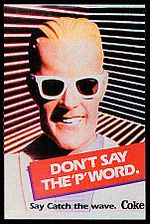
I rarely buy soda to drink at home, but I have long been a fan of Coke – I never did like New Coke as much as Classic Coke, except during the days of Max Headroom, when it was cool to take the taste test between Pepsi and Coke in the mall.  If you picked New Coke, you got a Max Headroom poster and other junk that I used to decorate my bedroom walls, along with cutouts of Ralph Macchio and Kirk Cameron from Tiger Beat or whatever the teen magazine of the day was.  Anyway, now I drink coffee all morning, but switch to a can or two of Coke in the afternoon.

It reminds me of my uncle.  I have never known anyone that likes Coke as much as he does.  In fact, his son’s first word was Coke.  We were all sitting at the dinner table, and my young cousin was somewhere around 2.  All of a sudden, hands flailing in his high chair, he yelled, “Coke!” in the sort of clipped voice of a newly talking toddler.  The rest of us laughed, so he repeated the phrase over and over and over.  My cousin is now out of high school, and I have no idea if he turned into a Coke drinker, but I’d be surprised if he didn’t, what with all the Coke my uncle always had in the house.  I do believe that nothing beats Mexican Coke, though.  They still use real sugar instead of corn syrup, and it is so much better.  Not to mention that drinking from a glass bottle is more reminiscent of youth and hot summers, whether or not you actually drank Coke from a bottle back then.

And more first lines

I’ve looked at first lines a couple times in the past, here and here.   Below are some others from books on my shelves…

The Stone Gods, by Jeanette Winterson.
This new world weighs a yatto-gram. But everything is trial-size; tread-on-me tiny or blurred-out-of-focus huge.

I like this opening because it evokes senses, but not quite images.  That makes me want to read further.  After looking through my notes and finding this blurb, though, I realize I’ve been unconsciously copying the hyphenated phrase style she uses here.  I am a big fan of Jeanette Winterson, so it doesn’t surprise me a ton.  What I like about this approach is that it alters the pace of the sentence itself.  Often, writers talk about pace in the context of a whole work, zooming into a scene and providing lots of detail and dialogue, slowing down the pace versus summarizing larger chunks of time passing with narrative.  I thought it was worth looking at pace within a sentence based on the use of language and punctuation itself, though.  The other thing I like about this style is that it’s a way of creating a new word when the right word doesn’t quite exist.

The Prince of Tides, by Pat Conroy.
My wound is geography. It is also my anchorage, my port of call.

I think these two lines work because they immediately introduce paradox.  When I think anchorage, I think home.  Comfort, familiarity.  When I think wound, pain and discomfort come immediately to mind.  I think this is a great introduction that at the very least, explains to the reader that place will be important, and the narrator’s association to that place will be complicated.

From My Father’s House, by Sylvia Fraser.
My father’s house was a three-story, frame building on a shady street in Hamilton, Ontario

I don’t like this first line that much.  It gives a bit of information, but it doesn’t hook me, beg me to read more.  Having read the book, I can say it is very well written, and a worthwhile read, and with the benefit of retrospect, the important element of this first line may be in its references to a large house – that can evoke a spooky feeling, especially from the perspective of a child.  The use of the word shady introduces a dark element, too.  When I read this the first time, though, those things didn’t mean anything to me yet.  To me, this is an example of how a great book can live without a great hook, though.

Middlesex, by Jeffery Eugenides.
I was born twice: first, as a baby girl, on a remarkably smogless Detroit day in January of 1960; and then again, as a teenage boy, in an emergency room near Petoskey, Michigan, in August of 1974.

This opening line tells the reader exactly what the story will be about, and the subject itself is unusual and promises to be intense.  References to place and time help set the stage for the inherent struggle the narrator will have in dealing with gender identity.  Most of the language is straightforward, unadorned, though the first four words imply the significance of the subject matter.  I like the combination of the gravity of the first phrase, and the almost boring everyday description of the remainder of the line.

Water for Elephants, by Sara Gruen.
Only three people were left under the red and white awning of the grease joint: Grady, me, and the fry cook.

“Only three people were left,” – this part of the sentence implies that we’re joining the narrator at some later point in the story – I expect to hear what led up to there being only three people left.  The terms “grease joint,” and “fry cook,” both make me think of lower class characters – people that don’t have much money.  The line isn’t earth-shattering, but it sets the stage a little bit, and the opening words make me want to read more.

When I can’t find the words

When I started this blog, I thought long and hard about the tagline for it, finally settling on ‘me and my battle with words.’  I probably should have spent more time thinking long and hard about the title of the blog itself, but I’ll save that for another discussion.  In any event, sometimes words come to me and sometimes they don’t.  Sometimes they just feel right, and other times I fight with words, trying to bend them to my will.  I have noticed that I don’t work so hard at finding the right words when I speak, though.  I used to worry about this a little more, thinking it was important to remember the right word, especially the name of something – a store, a person, an object.  A long time ago, a friend of mine had a particular boyfriend that had no memory for the names of things, and he just used whatever descriptive words came to mind when he couldn’t locate the name in his brain.  For instance, he called Payless Shoes “cheap shoe.”  We all laughed at the time, but really, I think it’s brilliant.  Just call things what they are – it’s actually more memorable.  In fact, in the middle of writing this post, I could not remember the name of ‘Payless Shoes,’ myself, as I’ve also come to think of it as “cheap shoe.”

I find that when I’m tired, I’m least likely to remember to use the right words.  Luckily, my partner is OK with this, and will generally sort out what I’m saying without too much trouble.  We use one of our cell phones as an alarm clock, so on the way up to bed, I ask if she has her clock.  When she takes too long to run through her bathroom routine at night, I holler to her that she’s late.  If the light is too bright in our bedroom, I’m apt to say I’m being blinded by the sun, especially when she finally finishes flossing her teeth and I’m half asleep having been waiting a long time for her to show up.  I’ve also taken to just leaving out some words that seem unimportant to the whole statement I’m trying to make. Why say an extra word if you don’t have to?  “Can you shut the light?” gets the point across just as well as “Can you shut off the light?”

There are a few Italian restaurants near our house, and they are often among the default places we go when we’re too tired to cook and need a menu a 7-year old will approve of.  We refer to them as “the dark place” and “the light place,” based on the difference in interior lighting.  Barney’s Gourmet Hamburgers is a popular small chain with a few locations in the  Bay Area.  Sometimes, “Barney’s” just doesn’t come to me, though, so I’ll call it “Frank’s burger,” or “Jack’s burger.”  All I really need is anyone’s name in front of “burger” and she knows what I mean.

I had to look up the name of a tiny tree we have planted in a garden in front of our house, because I call it the Harry Potter Tree.  It’s really named the Henry Lauder’s Walking Stick tree.  I love it because it’s so twisty.  I’d take a picture of ours to show you, but it’s dark outside right now, so this stock photo will have to do.  There are many more where these came from, but I am getting to be pretty tired, so they escape me at the moment.  What’s your shorthand?  Do you search for the right words or just use what comes most quickly?