Anecdotes from a wedding in Carmel

I was in Carmel for a wedding Saturday – a very close friend of mine that has struggled with addiction on and off for years was marrying a man she met four or five years ago in one of her stints in rehab.  They make a great pair, my friend has been sober for almost four years now, and it was a gorgeous and intimate affair with 45 people in attendance, including the happy couple.  My partner and I went along with another close friend (grass-phobia girl) and her boyfriend (who didn’t know she had a grass phobia until I outed her at the wedding).

The setting was a small beach house on the ocean, a perfect blend of warm sun and an ocean breeze, a score of surfers in the background riding big waves, and a little girl, maybe 9 or 10 years old, who wandered away from her family and to jump in hills of seaweed piled up on the shore as though they were large piles of autumn leaves (I have to admit, cute as she was, frolicking in the seaweed, the main thought in my mind was There is no way I would let you in my car after all that.).  In all, everyone seemed to enjoy themselves, and the most important thing was that my friend and her new husband looked as happy as any couple I’ve ever seen.  That said, there were a few humorous elements during the ceremony that seem worth sharing.

My friend and her husband were married by her husband’s sponsor, who also happens to be a “preacher,” as we were told.  They call him Brother Love.  I could easily picture him in front of a mesmerized bunch of parishioners, passionately shouting bible verses, pointing out individuals in the pews to repeat what he says to help him punctuate his already forceful statements.   There was a bit of awkward shuffling at the beginning of the ceremony as the bride’s father stood with her, waiting for the moment he was to “give her away.”  Brother Love was explaining that the thirty-something couple (who already live together) must be willing to leave the homes of their parents and build a new home together.

He ended by asking who was going to give the bride away, although it was evident that her father, standing immediately in front of him, was doing that part – “Um, … I will…,” said the bride’s father, which brought many chuckles from the guests.  He began to sit down, but Brother Love wanted the bride’s father to physically place his daughter’s hands into the hands of her husband-to-be.  To lookers on, it seemed none of this had been practiced at the rehearsal dinner.  While the awkward moment was underway, the groom’s father saw it as an opportunity to jump in and be part of the hand-off, which then turned into a “Go team!” kind of affair, with all the hands that had come together thrown into the air with exuberance.

In one part of the ceremony, Brother Love addressed both the bride, [C],  and groom, [P], alternately, giving them what sounded like life or death instructions on how they were to conduct themselves in their marriage.

“[P], in this marriage, you must care for your wife and have eyes only for her, and no other woman!”

“[C], in this marriage, you must trust your husband completely, knowing he will care for you and provide for you forever!”

“[P], you must give yourself up to your wife, put her interests first, and trust that your personal needs will be met by God!”

“[C], you, too, must give yourself up to your husband, put his interests first, and trust that your personal needs will be met by God!”

The bride alternated between curious expressions, glances into the audience, the occasional nod of the head, but mostly it seemed she was trying not to laugh.

“[C], you must keep your home orderly, must not be quarrelsome, nor contentious!”

At this point, the bride looked at Brother Love, with an expression that said, Who are you? Did you really just say that?

“[P], and you must give your wife what she is due!”

Brother Love followed his final instruction with an elbow to the groom’s ribs and a couple of exaggerated winks.  To everyone’s relief, they eventually made it through the ceremony and were proclaimed husband and wife.
Parental Secrets

Today is the day I would normally pull an excerpt from a book I love and share it with all of you.  However, I got some news I never would have expected to hear in my life on Saturday night, and I can’t seem to tell enough people about it, thus this blog entry.  I hope to get back on track later this week with other posts.

Here’s the bombshell news:  I have another sister I never knew about!  This is the first I’m hearing about my father having had another daughter besides the sister I grew up with, and the daughter he had with his second wife.

My family history is a bit complex, so first, a quick background.  My parents split when I was three and my sister, a year and a half old.  After the split, my sister and I lived with my mother for a year and a half or so, then we were sent to live with my father.  My father’s girlfriend had two sons, one my age, one three years older than me, so we became a blended family of four children, ages 3, 5, 5, and 8.  Three years later, my father and my step-mother had another child, so now we were five children, ages baby, 6, 8, 8, and 11.  When I was ten, my sister and I were sent to live with my mother again because my father was leaving my stepmother.  We had a hard time maintaining contact with my half-sister, who was 2 when we left, and my ex-step-brothers.  Periodically, I’d reconnect with them, but as the years have passed, they are less and less open to maintaining communication with me.  We lived through some hard times, which perhaps I’ll write about in the future, but suffice it to say it was a pain-filled period for all of us, and my father abandoned everyone at that time.

Saturday night, the mother of my half-sister told me she had been contacted by a daughter that she and my father had given up for adoption just before I came to live with them.  I had absolutely no idea they had another daughter.  My new half-sister had contacted her birth mother and asked if any of her newly discovered five siblings would communicate with her online.  She is five years younger than me and lives in England, and that’s about as much as I know.  Of course, I said I’d be happy to communicate with her – the ridiculous drama of our family life back then was insane, but regardless, if I can do anything to satisfy the curiosity of someone who has been adopted and clearly has a strong desire to learn about her birth family, I absolutely want to help.

This has raised a number of interesting conversations among my friends, my sister, and a few of my relatives on my mom’s side of the family.  Everyone is shocked to know I have another sister – personally my mind has been spinning, but somehow spinning with lots of emptiness – it’s hard to think about concrete things when you have a bombshell like that dropped on you.  I have yet to decide whether I’m going to talk to my father about the situation.  Many people have expressed shock that he never told me or my sister about this other daughter, but that doesn’t actually shock me at all.  Whatever the circumstances were that they chose to put this baby up for adoption, the decision was certainly theirs to make, and I don’t believe they had any  obligation to tell the rest of us kids.  I’m curious what perspectives others have, as I struggle with talking to my father about this.  I almost see it as an invasion of his privacy.  I’m the only child that has any contact with my father, so if it turns out my new sister intends to contact him, I may be the best suited person to talk to him about it, and if that happens, I will do so.  But, not knowing yet what her perspective is, I’m holding off for the moment.  Needless to say, this has interrupted my ability to think much about anything else.

More posts from around the blogosphere

Just a few links this week.  Enjoy!

Michael Haynes wrote a great post reminding us to use our everyday life experiences in our writing. Read his example here.

Christine Zilka’s U is for Urgency is a compelling short memoir piece that blends humor with the reality that we never know when our time will be up.

This short piece, a written observation of a small corner of nature on a college campus, left me feeling relaxed. Thanks, Hayley!

This beginning to a series about Amy Elizabeth’s observations of a homeless man is fascinating. It reminded me of an evening I once spent with a homeless man in San Francisco. Check it out!

Genealogy and Family Secrets

Depression is one of those plagues that weaves its’ way through generations in families, sort of like alcoholism.  My mom was depressed, her mom was depressed before her, and my sister struggled with depression even as a teenager.  I was depressed in my early twenties, and it hit me hard again when I began to have anxiety attacks in my late thirties. When I began researching my family’s history, I found there was some serious depression that ran in my family in earlier generations, too.

Some of these stories had been whispered about in my family for years, but if I openly asked about them, I was shut down in a second.  My grandparents are still from a generation where family secrets are just that – secrets.  Nonetheless, I set out to validate each taboo story and try to learn more about the details of each situation.  My  grandma’s mother, or my great-grandmother, was born in 1915, the youngest of three children.  Her oldest brother I’ll call Max and the middle child, Eric.  Their father died when they were all young, which would be only the beginning of a great deal of suffering and tragedy for the family.

As an adult, Max left Kiel, where they had grown up, and went to Milwaukee.  He worked as an auditor, and seemed to enjoy city life.  He wrote his mother regularly, and occasionally his little sister, too.  He told stories of the people he met in the city, described his efforts at finding a job, and one of his letters to his sister described a girl was quite smitten with.

Dear Sister,
I still have 20 some dollars in the bank.  If you can get it, I will send home the checkbook and you can withdraw it and pay your debts.  And, for God’s sake, have your tooth fixed.  I will send home some money if I can.
Give [Eric] the flannels, I don’t care.
[H] and I have been out all last week.  We have put in about 20 applications.  We are going out tomorrow again.
Well, sister, last Friday I had my first date.  I took her to the Wisconsin.  She is from Tomahawk, Wisconsin.  Her dad is mayor, vice president of a bank, and he owns a construction company.  He also has something in a paper mill.  She is the nicest girl I have ever met and she likes black wavy hair.  So, there you have it.
Write as soon as you get this so that I can send the book home.

Max

P.S.  I tried to have her teach me how to dance, but she can’t because she stays with 4 aunts and 4 cousins.  If you can get the money, pay my insurance.

Max had black, wavy hair.  At some point, he ended up in the service – the Army, I think.  No one in my family is sure why he joined, how long he served, or what he did, but he hated the experience.  He complained in his letters home to his mother.

Fort Sheridan, Il.
August 16, 1938

Dear Mother,
Monday and Tuesday we were at the rifle range, but I did not make marksmanship.  My shoulder was blue a little from shooting.  Next Monday and Tuesday we hike to the Great Lakes Naval Station, a distance of about ten miles, coming one day and going back the next.  We have to carry thirty-pound packs, rifle, mess outfits, and cartridge belts on the way.
Please write soon! Tell [G] and [E] to write too.  I have only gotten one letter so far from [S]. That’s a heck of a business. Some men are getting as many as three letters a day and I just have to sit there.  This is the address.  Don’t forget some of it as they get letters up here without even names on them or without the company.

Yours,
Max
C.M.T.C.  Co. F
Fort Sheridan, Illinois

He was discharged at the age of 29, near the end of 1941.  In early 1942, right after he turned 30, he received a telegram instructing him to report again for duty immediately.  He hung himself instead.

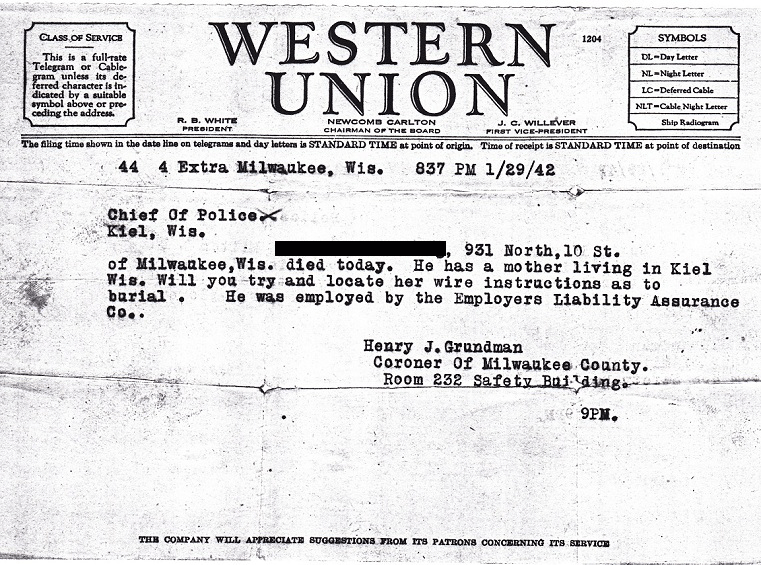
Although I didn’t doubt the truth of this story, I found newspaper articles that confirm the details.  In my grandma’s stack of papers, I found a Western Union telegram that was sent by the authorities in Milwaukee to the authorities in Kiel, giving them the details to pass onto his mother.  The family was devastated.

From the Milwaukee Journal:

Former Kiel Man is Found Dead

Milwaukee (AP).  [Max], age 30, an auditor, was released from the army last November because he was over 28. Wednesday he received notice to report immediately for further military service.  Yesterday his body was found hanging in his rooming house.  Police said he formerly lived in Kiel, Wis.

Death Notice by Telegram

This sad story makes me grateful for my life – grateful that in my many periods of darkness, I have never wanted to end my own life.  It also makes me grateful that those close to me in my family who have battled with depression never went so far as to write their own endings.  My grandma remembers little about her uncle, except that he was a sweet man.  She was eight when he took his life.  Whenever he came home to visit, he always had a small present for her.  Unfortunately, after his death, he became a family secret.  No one discussed him or his life any longer.  Perhaps it was because they felt shame about what he’d chosen to do when faced with a major obstacle in his life.  Perhaps it was because the pain of losing him was so deep.  Perhaps it was because they understood the temptation themselves, and knew it was best to keep it at bay by refusing to acknowledge it.

Inspiration in odd places

I used to frequent a website for entertainment when I had a few minutes to spare at work, and needed a mental break. Odd News always gave me something to laugh or puzzle about, and I was truly shocked at the number of odd news stories that originated in or around my home town, like this story about a man urinating on a police officer. Wouldn’t you know, this guy was in my high school graduating class!

I saw this headline (Arrest in mass tire slashings) on the SF Chronicle home page yesterday, and it reminded me that these ridiculous news stories can be great inspiration for developing quirky characters, or exposing some hidden neurotic desires that a character might never share openly, but secretly wishes he or she could act upon.

What might possess someone to become a serial tire-slasher? Did you have any idea that a person could be charged with “felony discharging bodily fluids at a public safety worker?” Digging into these and other odd news stories could yield some really fascinating and hilarious character content.

More First Lines

I wrote a post recently on the first lines that open books. Below are five more first lines and my thoughts about them…  I did cheat a bit in two cases, and I included the first few lines because despite the punctuation, I felt they were meant to be read together.

Then We Came to the End, by Joshua Ferris.
We were fractious and overpaid.

I recently shared an excerpt of this novel, Joshua Ferris’ debut.  I loved the book, and identified with the humor of the ad agency world contained within it.  This first line is incredibly short and simple, but I think it grabs the reader very effectively.  The line clearly indicates the story will be about a group of people and have something to do with jobs.  The reason I love the line, though, is because of the use of the word “fractious.”  What an awesome word, and one I doubt I’ve seen in print anywhere!  Dictionary.com gives two great examples of the meaning and use of the adjective:

1. refractory or unruly: a fractious animal that would not submit to the harness.

2. readily angered; peevish; irritable; quarrelsome: an incorrigibly fractious young man.

Looking at this first line after having read the book, I couldn’t possibly pick a more appropriate opening line, and I think that also underscores it’s effectiveness.

The History of Love, by Nicole Krauss.
When they write my obituary. Tomorrow. Or the next day. It will say, LEO GURSKY IS SURVIVED BY AN APARTMENT FULL OF SHIT.

I absolutely love this first line, and I loved the novel.  The reader is introduced to Leo Gursky, the main character, and knows the story will be narrated by him.  It also immediately introduces sarcasm and humor, both of which are big pluses in my book.  The narrator’s name to me reads “quirky,” and I know that Leo is old or doesn’t expect to live long for some other reason.  If you’ve never read this book, go get it.  It’s brilliant.

The Sunflower, by Simon Wiesenthal.
What was it Arthur said last night?

This simple first line doesn’t tell the reader a whole lot, but it does instantly convey that he is not in top mental shape.  It sets the mood, though, as I quickly pictured myself with eyebrows scrunched, searching my memory for something I couldn’t quite remember.  I love that readers do that – fill in details themselves as they read, whether its’ picturing themselves or another person with an expression that’s well-described, or painting a picture in their heads of a character, even though only certain details are provided by a story.

Fool’s Crow, by James Welch.
Now that the weather had changed, the moon of the falling leaves turned white in the blackening sky and White Man’s Dog was restless.

This sentence primarily sets a scene, though it also introduces the main character and illustrates his general state of mind.  The language is descriptively rich, and continues that way throughout the book.  As a tale of Native American life, this type of description runs throughout the entire novel.  I don’t believe it is the type of first line that completely grabs the reader, but the question of why White Man’s Dog is restless is compelling, and the many references to nature, weather, and season do set a certain ambiance.

Lighthousekeeping, by Jeanette Winterson.
My mother called my Silver. I was born part precious metal part pirate.

Again, these statements are classic Winterson.  You know instantly that you’ll be reading a tale that has some fantasy in it.  Punctuation is missing, which subtly reinforces the concept that this character is  truly a combination of precious metal and pirate – there is nothing to separate the two elements of the character.  The unique and odd combination itself begs for more information, so I think these lines do their job.

 What are some of your favorite first lines?  Or, if you don’t have any off the top of your head, open up a couple books and jot them down – what do they do for you?

Quotes from my crazy great-grandmother

This weekend, I went through my box of stuff. That box of letters, random medals I got in high school band, newspaper clippings about me or someone in my family – the stuff you keep because it seems important. I came across seven letters from my great-grandmother. I was never actually very close to her. She lived in Illinois, while the rest of my family lived in Wisconsin. We saw her once a year at Christmas, or at big events, like my confirmation, and it was always awkward because no one was close to her. She drove my grandma nuts, and she always made pointed statements that someone would take offense at.

When I was in my mid-twenties, though, I started writing to her. It began because I was planning my first international trip, to Thailand, and my great-grandmother had traveled extensively in Southeastern Asia, which was odd for anyone in my family, but doubly odd given her generation. She traveled before travel was so easy as it is today, and at a time when it was common to hire guides in foreign countries. She was the only person I knew who had traveled internationally, though, and I was curious about her experiences. She was 82 at the time I started this little communication stint, and her mind had already begun to decline some, so all I got from her was this:

“Our guide in Thailand was not one of our favorites. All he knew was about the film made there of The King & I. He also had his girlfriend along which I’m sure he wasn’t supposed to have done. Our guide in Hong Kong told us his name was Charlie Chang, but of course, it wasn’t.”

That was it. I would have loved to learn more, but she was a woman of few words. I’ve been meaning to talk to some relatives so I can capture some examples of the statements she used to make that offended people. I look back at these stories as amusing, but if I ever write about her, I want to be able to include some specifics. I will still have those conversations with family members that knew her better than I, but I found some gems in the letters she sent me. Below are a few.

“Don’t ever say anything, but [My uncle’s wife] always sends me a birthday card and says they will be up to take me to lunch, but never come here.  [A different grandson and his wife] are the only grand-kids that come to see me. they usually go home with a few treasures.”

She loved her “treasures,” random antiques and knick knacks she often bragged about, and dangled like bait  for those who did come to visit.  Then even when my uncle referred to above did visit, she said…

“[My aunt and uncle] stopped by for a day while they were with their golf group.  Haven’t seen the kids since a year ago X-mas and they sure have grown. [My cousin] isn’t quite the cry baby he used to be.”

That was her way of making a compliment.  She probably didn’t say that directly to my uncle, but even her compliments were thinly veiled judgments of one sort or another.  Another excerpt…

“Your grandmother ([Grandma’s name inserted here, as though I don’t know who she is]), is unhappy with me as I called [Grandma’s husband] early in June and told him I had a bladder infection, so she told me she wasn’t going to call me unless I call her. [My name], she never calls me anyway. I could lie here dead for a month and she wouldn’t know the difference. (Don’t say anything to her.)”

The underline in her letter was a bit squiggly, but it was there.  She loved to speak her mind, but always commanded me not to tell anyone what she said.  I’m positive she made random negative comments about me to others as well.  None of us was immune, which was probably the primary reason no one was every very close to her.  She was certainly a character, though.

“Went to a pig roast yesterday with my friend Ruth.  Farmers in her area have that each year.  I haven’t used salt for about 30 years, but they sure had enough on the meal yesterday.  Love, Grandma V.”

She spent her last ten years or so in a nursing home as her dementia escalated to the point where she didn’t really recognize anyone except possibly her own kids.  Her son had been working on getting her to move back to Wisconsin so she was near family as she aged, but she didn’t want to.

“He thinks I should probably move back to Wisc., but I have friends here and I like my Mobile Home.  Don’t want to live with a bunch of old ladies who want to know all your business.”

I love it that she always capitalized “Mobile Home.”  In the nursing home, she quickly developed a reputation as someone who spouted out insults to those around her.  Despite her biting remarks, I have respect for how she lived.  She got divorced after 40 years of marriage because she’d had enough of her husband’s drinking.  That takes a different kind of strength for someone that grew up in the 1920s than it does for people of more recent generations.  She was probably around 60, and she lived on her own after that, supporting herself, and doing things she enjoyed.  Her travels fascinated me, given how uncommon it is for people from my neck of the woods, and even more so for that travel to have occurred when it did.  I don’t know the exact dates, but it was definitely before 1970.  She passed away last December at the age of 95, and although we were never close, I’m glad to have known her.

Memory Loss

The first campaigner challenge calls for a 200 word short story/flash fiction, beginning with the phrase, “The door swung open…” Below is my entry for the challenge. Enjoy!  If you are so inclined after reading, you can vote for it (#183) here.

Memory Loss

The door swung open – a door that was locked for years, guarding feelings of pain and loss, banished in the black cellar of my brain.  With it, my past attacked me, bent on revenge.  Debilitating anxiety replaced the solid thoughts that once roamed my mind.  Even when I try to look hard at the memories of my twenty-two year old self, face them down, give them their moment in the spotlight, I can’t locate them.  Instead, there is sorrow, confusion.  I rack my brain for details that will bring her back to life, if only on the pages.  Her death made it impossible for me to come to terms with our life.  I convinced myself it was something much smaller than it was – because she left me early – because I called it a relationship that wouldn’t have lasted anyway.  I minimized it in every possible way, no idea how much I was minimizing her, minimizing me.  I fumble through the few things I have left of her – a few letters, a prescription bottle – anti-nausea pills, a handful of photographs.  They don’t tell enough.  They don’t fill in the gaps that I so desperately need to fill in.

The Stone Gods

I finished The Stone Gods, by Jeanette Winterson, yesterday. I have been working on making my way through the last half dozen or so things she’s published, and one of the things I love most about her writing is her ability to capture darkness, loneliness, sorrow, wonder, loss. The darkness that is inside all of us, the weighty parts of our souls, our inability to comprehend our place in the universe, or define the why’s of our experience, our existence. This is just a short passage from the book, but it spoke to me.

Far out, too far to see with the human eye or to hear with the human ear, is everything we have lost. We add to that loss feelings that are unbearable. Send them out into deep space, where we hope they will never touch us. Sometimes, in our dreams, we see the boxed-up miseries and fears, orbiting two miles up, outside our little world, never could rocket them away far enough, never could get rid of them forever.
Sometimes there’s a signal, and we don’t want to hear it: we keep the receiving equipment disused, we never updated the analogue computer. Shut off, shut down, what does it matter what happens if we can’t hear it?
But there it is – a repeating code bouncing off the surface of the moon. Another language, not one we speak – but it is our own.
I don’t want to recognize what I can’t manage. I want to leave it remote and star-guarded. I want it weightless, because it is too heavy for me to bear.

Great posts from around the blogosphere

Below are links to some of the posts I most enjoyed reading in the past week.  Check them out!

Charlie Hale has such a graceful style about his writing.  This post, Friends and Lovers: In Passing Years, is particularly eloquent, though that can be said about everything he writes. Charlie has a way of reaching right into your soul with his words.

Julie Farrar wrote a post about road trips that will get you reflecting on your favorite car travel memories.

Check out this Star War’s fan’s well-written take on changes to a classic and who really “owns” art, anyway. I spent some time reading through other posts Graham has made, and his writing is insightful and thought-provoking. Don’t miss it!

I can’t resist another homage to the 80s, this one on favorite songs.

I’ve read a few of The Wandering Atavist’s posts about his horrible luck with women, and this one is hilarious, as are the others.

Enjoy!